How to Write Wedding Vows: A 5-Part Structure, Prompts and Examples
By Altar & Agenda · Updated
Writing your own wedding vows is one of the most meaningful parts of planning, and one of the easiest to put off. The blank page is the hard part. Once you have a few true stories and a simple structure, most vows come together in a couple of short sessions.
Here's a step-by-step method you can follow over a week or two, with prompts, a structure and a short example.
On this page
- Before you write: agree on the ground rules
- Session 1: collect memories (20 to 30 minutes)
- Session 2: draft with a five-part structure (20 to 30 minutes)
- Session 3: check the length and edit (15 to 20 minutes)
- Session 4: practice and prepare for the day (15 minutes)
- Writing vows for an elopement or small ceremony
- Frequently asked questions
- Want a guided workbook?
Before you write: agree on the ground rules
Have a five-minute conversation with your partner first. It prevents the most common vow regret: one person reads two heartfelt minutes and the other reads four lines.
Agree on:
- Length. Roughly how long each of you will speak (see the length guide below).
- Tone. Heartfelt, lighthearted, or a mix. A joke or two is lovely; a stand-up set is less so.
- Surprises. Will you share your vows with each other beforehand, or hear them for the first time at the ceremony?
- Anything off-limits. Exes, private stories, or anything you wouldn't want grandparents to hear.
Also check with your officiant. Some ceremonies, particularly religious ones, have traditional vows or expectations about what's included.
Session 1: collect memories (20 to 30 minutes)
Don't try to write vows yet. Just answer prompts, quickly, in bullet points. Aim for honest and specific rather than polished.
- When did you know?
- What's a small moment with them you think about often?
- What's something they do that nobody else seems to notice?
- How have you changed since you met?
- When did they show up for you when it really mattered?
- What made you laugh hardest together?
- What's an ordinary day with them like, and what do you love about it?
- What do you want your future together to feel like?
- What's a challenge you got through together?
- What would you want them to remember on a hard day?
When you're done, circle the two or three answers that made you feel something. Those are your raw material.
Session 2: draft with a five-part structure (20 to 30 minutes)
Most good vows follow a shape like this:
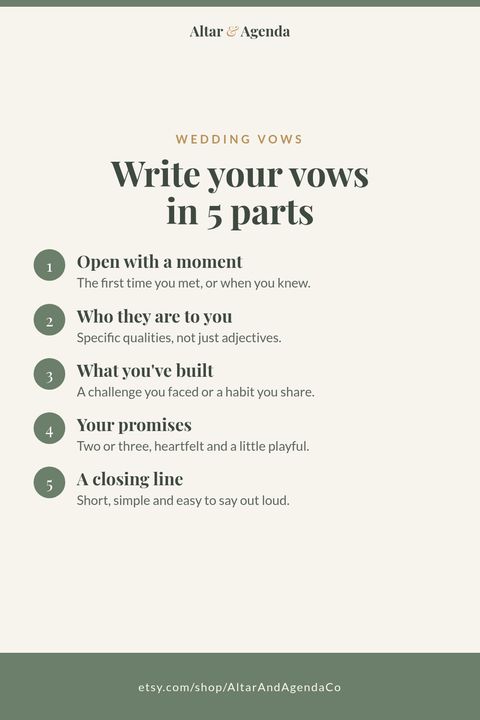
- Open with a moment. Start with a specific memory: the first time you met, the moment you knew, a small scene that sums them up. Specific beats general every time.
- Who they are to you. Describe them through actions, not adjectives. "You're kind" is fine. "You learned my grandmother's recipe so she could teach it to you" is unforgettable.
- What you've built together. A challenge you faced, a habit you share, something you've learned from each other.
- Your promises. Two to four promises, ideally mixing heartfelt with a little lighthearted. Promise starters help: "I promise to...", "I will always...", "Even when..., I will...".
- A closing line. Short, simple and easy to say with a shaky voice. It often echoes your opening moment.
A short example (fictional)
The first time I met you, you were arguing with a vending machine, and losing. I offered you my last coin, and you've been paying me back with interest ever since.
You're the person who remembers my sister's birthday before I do. You make every stranger feel like an old friend, and every hard week feel smaller.
We've moved three times, raised one very stubborn dog and learned that neither of us can assemble furniture without a break for snacks.
I promise to keep choosing you, in the easy years and the hard ones. I promise to listen before I fix. I promise to always share my snacks, and most of my coins.
You've been my favorite person for six years. Today, I get to make it official.
That's about 130 words, close to a minute when spoken slowly. For more, including vows for him, vows for her, short, funny and vow renewal examples, see our page of original wedding vow examples.
Session 3: check the length and edit (15 to 20 minutes)
A rough guide for spoken vows, at an unhurried pace of around 130 words a minute (everyone's pace is different, so time yourself):
| Speaking time | Approximate words |
|---|---|
| 30 seconds | ~65 |
| 1 minute | ~130 |
| 90 seconds | ~200 |
| 2 minutes | ~260 |
Most couples land somewhere between one and two minutes each.
Then run an editing pass:
- Cut anything that needs explaining. Inside jokes are great if one sentence makes them land for the room.
- Swap adjectives for examples. Look for "amazing", "wonderful" and "perfect", and replace them with something they actually did.
- Check the balance. Your vows should be about them and your future, not mostly about you.
- Watch the clichés. One "soulmate" is fine. Three is a greeting card.
- Read it out loud. Rewrite any sentence you stumble over. Shorter sentences are easier to say when you're emotional.
- Keep promises you can keep. Specific and realistic beats grand and vague.
Session 4: practice and prepare for the day (15 minutes)
- Read it aloud three or four times over the week before the wedding, ideally standing up. You don't need to memorize it.
- Print it. Reading from a vow card or small booklet looks much better in photos than reading from your phone, and it won't light up with notifications.
- Give a copy to someone you trust (your officiant or best person), in case you forget yours.
- Slow down on the day. Pause after the funny lines and the emotional ones. Breathe before your closing line.
After the wedding, keep a copy of both sets of vows somewhere safe. Many couples frame them or reread them on anniversaries.
Writing vows for an elopement or small ceremony
If it's just the two of you (plus a photographer and officiant), you have more freedom. Vows can be longer, more private and more personal. Some couples read them at a different moment from the legal ceremony, such as at a viewpoint after a hike. Our elopement planning checklist covers the rest of the logistics.
Frequently asked questions
How long should wedding vows be?
Most couples speak for one to two minutes each, roughly 130 to 260 words. Agree on a length with your partner first so your vows feel balanced.
When should I start writing my vows?
Two to three weeks before the wedding gives you time for four short sessions without pressure. Many couples aim to finish a week before, leaving time to practice.
Is it okay to read vows from a card?
Yes, and it's the norm. A printed vow card or small booklet looks better in photos than a phone and won't light up with notifications.
Do both partners have to write their own vows?
No, but agree on the format together. Some couples both write personal vows, some use traditional vows, and some combine traditional vows with a short personal message.
How do I end my wedding vows?
With a short, simple line that's easy to say when you're emotional. Echoing your opening moment works well, as in the example above.
Want a guided workbook?
If you'd like more prompts and a place to write, our Wedding Vow Workbook walks you through four short sessions with 10 memory prompts, 12 promise starters, the five-part structure, a fill-in template, three example vows, a length guide and practice log, an editing checklist, and printable vow cards and an "Our Vows" keepsake page. It comes as a printable PDF plus an editable Word / Google Docs version, and it's included in the Wedding Planner Bundle.
Planning the rest of the wedding? Start with our free 12-month wedding planning checklist.
Sources
- The Knot Worldwide, 2026 Real Weddings Study press release: 61% of couples wrote their own vows.
Disclosure: Altar & Agenda makes the workbook linked above. The example vow is fictional. Word counts are estimates.
Free: one-page 12-month wedding checklist
60 tasks from "set your budget" to thank-you notes. PDF, no sign-up.
Get the free checklistBrowse our planners on Etsy