Elopement Planning Checklist: How to Plan an Elopement or Micro Wedding
By Altar & Agenda · Updated
Eloping no longer means sneaking off to the courthouse without telling anyone (though that's still a perfectly good option). Today it usually means a small, intentional wedding: just the two of you, or a handful of guests, somewhere that means something to you.
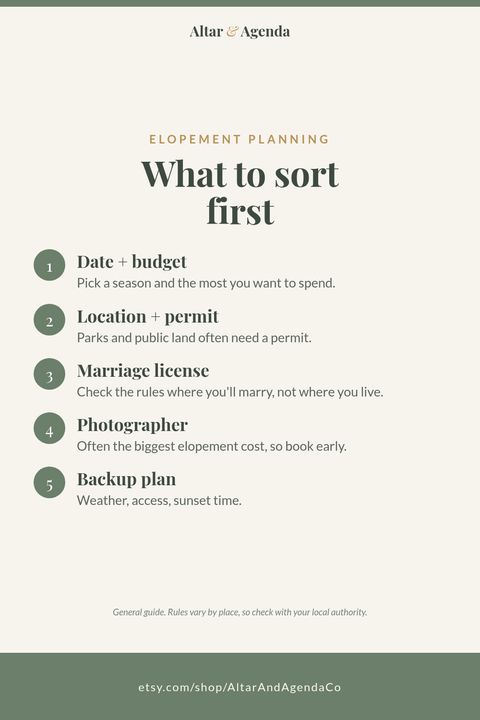
Small doesn't mean no planning, though. Elopements have their own logistics: permits, marriage license rules in a place you may not live, weather, sunset times and getting everyone (and the rings) to a viewpoint on time. This checklist covers it in order.
On this page
- Elopement vs. micro wedding: which are you planning?
- Step 1: Set your date range and budget
- Step 2: Choose and compare locations
- Step 3: Check permits and rules
- Step 4: Sort out the marriage license
- Step 5: Book your photographer (and officiant)
- Step 6: Plan the day-of timeline around the light
- Step 7: Plan for guests (micro weddings)
- Step 8: Write your vows
- Step 9: Pack the day-of kit
- Step 10: After the elopement
- Frequently asked questions
- Want it all in one place?
Elopement vs. micro wedding: which are you planning?
There's no official definition, but couples generally use the terms like this:
- Elopement: the two of you, plus an officiant, photographer and any required witnesses. Sometimes a few very close people.
- Micro wedding: a small guest list, often up to about 20 to 30 people, usually with a meal or small celebration.
| Courthouse wedding | Elopement | Micro wedding | |
|---|---|---|---|
| Guests | A witness or two | None to a handful | Usually up to about 20 to 30 |
| Location | Clerk's office | Somewhere meaningful (park, mountain, beach, city) | Restaurant, home, small venue or outdoors |
| Main costs | License and ceremony fees | Photographer, travel, permits | Photographer, food, venue |
| Planning time | Days to weeks | Weeks to months | A few months |
If the legal part is all you need, our courthouse wedding checklist covers clerk's office ceremonies step by step. The checklist below works for elopements and micro weddings. Micro weddings just add a guest list, RSVPs and possibly seating.
Step 1: Set your date range and budget
Start with the same two decisions as any wedding: when, and how much.
- Pick a season or date range. Location, weather and daylight all depend on it. Weekdays are often easier for permits and popular viewpoints.
- Set a total budget and split it across the categories that matter for small weddings: photographer, travel and lodging, permits and fees, attire, officiant, flowers, a celebration meal and a buffer.
For many elopements, photography is the biggest single cost, because the photos are how you'll share the day. Travel and lodging is often second. Our wedding budget breakdown by percentage includes a suggested split for small weddings, and the wedding budget spreadsheet guide shows how to track deposits and due dates. For context, The Knot's 2026 Real Weddings Study found weddings with 1 to 50 guests averaged $17,100 in 2025, roughly half the cost of the average wedding.
Step 2: Choose and compare locations
Shortlist two to four ceremony spots and score each one on:
- Cost: permits, entrance fees, travel and lodging nearby.
- Privacy: how busy it is at your time of day and season.
- Scenery: what it will look like in photos at the time you'll be there.
- Access: how far the walk is, and whether any guests can manage it.
- Backup plan: what you'll do if the weather turns or access closes.
Weight the factors that matter most to you (privacy might count double, for example) and add up the scores. It's a surprisingly good way to settle "the mountain or the beach?"
Step 3: Check permits and rules
Many parks, beaches and public lands require a special use permit or ceremony permit, sometimes with limits on group size, times, décor, music or drones. Some popular spots book up or restrict ceremonies in peak season.
For each location, write down:
- Is a permit needed? Who issues it, and how far ahead do you need to apply?
- What does it cost, and what does it allow (group size, chairs, arches, flowers)?
- Are there time restrictions or quiet hours?
Rules vary a lot by place, so always check with the land manager or park office directly.
Step 4: Sort out the marriage license
This is the step people most often leave too late. Marriage license rules depend on where you're getting married, not where you live. Questions to answer for your location:
- Where do you apply, and can you apply online or must you appear in person?
- What ID or documents do you both need?
- Is there a waiting period before the license is valid, and how long is it valid for?
- How many witnesses do you need, if any? Who can officiate?
- Who returns the signed license, and by when?
- What's the fee?
If you're marrying abroad, the requirements can be much more involved, and some couples choose to do the legal ceremony at home and a symbolic one at their destination. Check with the local registry office or your country's government travel and marriage guidance.
Step 5: Book your photographer (and officiant)
Book your photographer as soon as your date and location are settled. Elopement photographers often help with location ideas, permit tips and timing, which makes them especially valuable if you're marrying somewhere new.
Then book an officiant (or check whether you can self-solemnize where you're marrying; a few places allow it) and line up any required witnesses. Your photographer can sometimes serve as a witness, but check the local rules.
Step 6: Plan the day-of timeline around the light
Elopement timelines are usually built backwards from sunset. Look up the sunset time for your date and location, then work out:
- When you need to start getting ready.
- Travel time to the location, plus parking and walking time.
- Ceremony time (often an hour or two before sunset for softer light).
- Portraits, then any celebration meal.
Add buffer time everywhere, especially for walks and drives. And flag anything planned after sunset so nobody is hiking down in the dark without headlamps.
Step 7: Plan for guests (micro weddings)
If you're inviting people:
- Keep a simple guest list with party size, RSVP status, meal choices and dietary notes.
- Share clear directions, parking info and what to wear (shoes matter at outdoor locations).
- Plan a celebration: a private room at a restaurant, a picnic, a rented house dinner.
Our guest list and RSVP guide has a simple system for this.
Step 8: Write your vows
With fewer people listening, elopement vows can be longer and more personal. Our guide to writing wedding vows has prompts, a structure and a length guide, and our wedding vow examples include short vows that suit small ceremonies.
Step 9: Pack the day-of kit
Keep everything important in one bag and give it to one person:
- Marriage license and both IDs
- Rings
- Printed vows
- Permit printout
- Warm layers and a rain layer
- Comfortable shoes for the walk in (and your ceremony shoes)
- Emergency kit: safety pins, stain remover, blister plasters, pain relief, tissues
- Water and snacks
- A blanket for photos
- Phone charger or power bank
Step 10: After the elopement
- Make sure the signed license is returned on time.
- Back up your photos when the gallery arrives.
- Send an announcement, or plan a later party for the people who weren't there.
- Start any name-change paperwork if it applies to you.
Frequently asked questions
How much does it cost to elope?
It varies hugely. The legal minimum is a marriage license (often under $100 in the US), but most elopement budgets go mainly on photography and travel. Set a total first, then split it across photographer, travel and lodging, permits, attire and a celebration meal.
Do you need a permit to elope in a national or state park?
Often, yes. Many parks and public lands require a special use permit for ceremonies, with rules on group size, timing and décor. Check with the specific park or land manager well ahead of time.
How far in advance should you plan an elopement?
Three to six months is comfortable for most, especially if you need permits, travel or a popular photographer. A local courthouse elopement can come together in a few weeks.
Do you need witnesses to elope?
It depends on where you marry. Some places require one or two witnesses, and a few allow self-solemnization with no officiant. Your photographer can sometimes serve as a witness, but check local rules.
What's the difference between an elopement and a micro wedding?
An elopement is usually just the two of you (plus officiant, photographer and any required witnesses). A micro wedding has a small guest list, often up to about 20 to 30, usually with a meal or celebration.
Want it all in one place?
You can do all of this with a notebook and a calendar. If you'd like it in one spreadsheet, our Elopement & Micro-Wedding Planner for Excel and Google Sheets includes a 38-task checklist dated from your wedding day, an elopement-sized budget, a location compare tab, marriage license and permit questions, a sunset-aware day-of timeline, a micro-wedding guest list and a pre-filled 22-item day-of kit. Planning a trip afterwards? The Honeymoon Budget & Trip Planner pairs with it.
For a full-size wedding, start with our free 12-month wedding planning checklist.
Sources
- The Knot, The Average Wedding Cost (2026 Real Weddings Study): cost by guest count.
Disclosure: Altar & Agenda makes the templates linked above. This is general guidance, not legal advice; permit and marriage license rules vary by location, so check with the issuing office.
Free: one-page 12-month wedding checklist
60 tasks from "set your budget" to thank-you notes. PDF, no sign-up.
Get the free checklistBrowse our planners on Etsy