How Many Wedding Guests to Invite (and How Many Will Actually Come)
By Altar & Agenda · Updated
Almost every couple asks the same question at some point: if our venue holds 120, how many people can we invite? Not everyone you invite will come, so in theory you can invite a few more than your headcount. In practice, inviting too many is one of the most stressful mistakes you can make, because there's no polite way to un-invite someone.
This guide explains how many guests typically decline, how that changes for out-of-town and destination weddings, the math for common wedding sizes, and how to decide on a safe number. Want to run your own numbers? Use our free wedding guest count calculator.
On this page
- How many invited guests decline?
- The guest count math
- Invite only what your venue can hold
- How many people to invite for a 100-person wedding
- How many people to invite for a 150-person wedding
- Plan for no-shows too
- How your guest count drives your budget
- How to cut a guest list fairly
- Track every RSVP in one place
- Frequently asked questions
- Want it done for you?
How many invited guests decline?
The most widely used rule of thumb is that about 20% of invited guests will decline, so roughly 80% say yes. That figure comes from The Knot's editors, who suggest starting at 20% and adjusting up or down for your situation. Other planners quote a range of 10 to 20%.
The important word is "adjusting". Your real decline rate depends heavily on who you're inviting and how far they have to travel:
| Guest type | Typical decline rate | Why |
|---|---|---|
| Close family and wedding party | 0 to 5% | They plan around your date |
| Local friends and family | 10 to 15% | Mostly scheduling conflicts |
| Out-of-town guests (travel and hotel needed) | 20 to 30% | Cost, time off, childcare |
| Destination wedding guests | 40 to 50% | Flights, passports, multi-day trip |
| Coworkers, distant relatives, "courtesy" invites | 30% or more | Lower personal stake |
Destination weddings are the biggest exception. Wedding venues and planners commonly quote attendance of 70 to 80% for a regular wedding but only 50 to 60% for a destination celebration. Season matters too: holiday weekends and peak summer dates collide with other plans, while a Friday in January may get more declines from people who can't take the day off.
The guest count math
Your expected headcount is just your invited list multiplied by the share you expect to attend, done separately for each group of guests:
Expected guests = (local invited × local attendance rate) + (out-of-town invited × out-of-town rate) + ...
Here's a worked example for a couple inviting 140 people:
| Group | Invited | Expected attendance | Expected guests |
|---|---|---|---|
| Close family and wedding party | 30 | 97% | 29 |
| Local friends and family | 70 | 87% | 61 |
| Out-of-town guests | 40 | 75% | 30 |
| Total | 140 | 120 |
So inviting 140 gives an expected headcount of about 120, which looks like a perfect fit for a 120-person venue. But "expected" is an average, not a promise. Some years everyone comes.
Invite only what your venue can hold
Here's the rule most planners agree on, including The Knot: your budget and venue should be able to handle your full invited list, even if you expect some declines. If you invite 140 people to a venue with a hard maximum of 120, and 132 say yes, you have a fire-code problem, not an etiquette problem.
A safer approach:
- Find your venue's true maximum for a seated dinner (not standing cocktail capacity), and your budget's maximum headcount.
- Invite no more than that number on your A-list.
- Use a B-list carefully. If early RSVPs come back with more declines than you expected, you can send a second wave of invitations. Send the first wave early enough (eight to ten weeks before) that the second wave still arrives well before the RSVP deadline, so nobody feels like an afterthought.
If you really want to invite beyond capacity, keep the overage small (no more than about 5 to 10%) and only for groups with predictable high decline rates, such as out-of-town coworkers.
How many people to invite for a 100-person wedding
If you want about 100 guests and most of your list is local, invite roughly 110 to 120, provided your venue and budget can stretch to 120 if everyone comes. With a large out-of-town contingent, you might expect 100 from an invited list of 125, but again only if the venue could cope with more.
How many people to invite for a 150-person wedding
For a 150-person headcount with a mostly local list, invite around 165 to 180 under the same condition. The bigger the list, the more reliably the averages hold, because one large family saying yes or no matters less.
Plan for no-shows too
Even after RSVPs are in, a few people who said yes won't come on the day: illness, travel problems and last-minute emergencies happen. A small handful of no-shows is normal. Don't reduce your final headcount for this, though. Caterers charge for the number you guarantee, and it's far better to have three empty chairs than three hungry guests.
What you can do is avoid surprises in the other direction: make it clear on the invitation and envelope who is invited (names, "and guest" or not), so you don't get unexpected plus-ones and children.
How your guest count drives your budget
Guest count is the biggest lever on your wedding budget. The Knot's 2026 Real Weddings Study put the average cost at $292 per guest in 2025, and average total cost by size looked like this:
| Guest count | Average wedding cost (2025) |
|---|---|
| 1 to 50 guests | $17,100 |
| 51 to 100 guests | $27,200 |
| More than 100 guests | $43,300 |
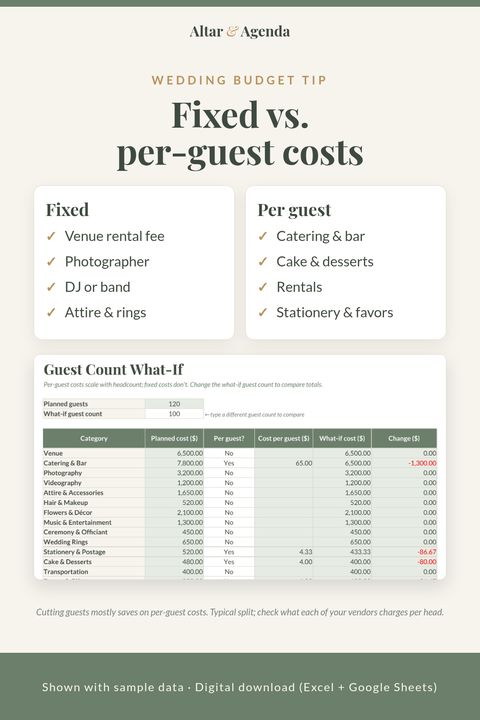
Not every cost scales with guests, though. Photographers, DJs and officiants usually cost the same for 80 people or 150, while catering, bar, rentals, cake and stationery go up with every person. Our wedding budget breakdown by percentage explains how to separate fixed and per-guest costs so you can see what a smaller list really saves.
How to cut a guest list fairly
If the numbers don't work, these approaches keep the cuts consistent (and easier to explain):
- Cut by category, not by person. "No coworkers" or "no plus-ones unless you're in a relationship" is easier to defend than picking individuals.
- Use the "have we met their partner?" test for plus-ones, and the "have we seen them in the past year?" test for friends.
- Decide on children early. "Adults only", "immediate family only" or "everyone welcome" all affect your count by a lot.
- Split the list fairly between each of you and any contributing family. Even splits (thirds or halves) are common, but some couples split in proportion to who's paying.
Track every RSVP in one place
Once the invitations go out, the only number that matters is the real one. Track it in one list with one row per invitation, a party-size column and an attending column, so your headcount updates as replies come in. Our guest list and RSVP tracking guide shows exactly how to set it up, including formulas for headcounts and meal counts.
Frequently asked questions
What percentage of wedding guests decline?
About 20% is the most common rule of thumb, with a typical range of 10 to 20% for a local wedding. Expect more declines from out-of-town guests and many more (often 40 to 50%) for a destination wedding.
How many people should I invite for 100 guests?
Around 110 to 120 if most guests are local, but only if your venue and budget can handle the full number. Never invite more people than you could actually host.
Do more people decline destination weddings?
Yes. Travel cost and time off mean attendance is often only 50 to 60% for destination weddings, compared with 70 to 80% for a typical hometown wedding.
When should I give my caterer a final headcount?
Usually about two weeks before the wedding, but check your contract. Set your RSVP deadline at least a week or two before that, so you have time to chase late replies.
Should I invite a B-list?
It can work if you're discreet and send the first wave early. Many etiquette experts advise inviting everyone at once instead, because B-list guests can tell when an invitation arrives late.
Want it done for you?
Estimate your headcount in seconds with our free wedding guest count calculator. When invitations go out, our Guest List & RSVP Manager for Excel and Google Sheets tracks party sizes, RSVPs, meal counts and table assignments, with automatic headcounts. It's also included in the Complete Wedding Planner.
New to planning? Start with our free 12-month wedding planning checklist.
Sources
- The Knot, What Percentage of Wedding Guests RSVP Yes?: the 20% decline rule of thumb and advice to budget for the full list.
- Inside Weddings, Etiquette Rules for Managing Your Guest List: 10 to 20% regrets and B-list advice.
- Molto Bella Weddings, Low Attendance at Your Wedding?: typical attendance of 70 to 80%, and 50 to 60% for destination weddings (citing Inside Weddings).
- The Knot, The Average Wedding Cost (2026 Real Weddings Study): cost per guest and cost by guest count.
Disclosure: Altar & Agenda makes the templates linked above. Decline rates are rules of thumb, not guarantees; the per-group rates in the tables are our planning estimates based on the sources above.
Free: one-page 12-month wedding checklist
60 tasks from "set your budget" to thank-you notes. PDF, no sign-up.
Get the free checklistBrowse our planners on Etsy