How to Split Wedding Costs Between Families (Who Pays for What)
By Altar & Agenda · Updated
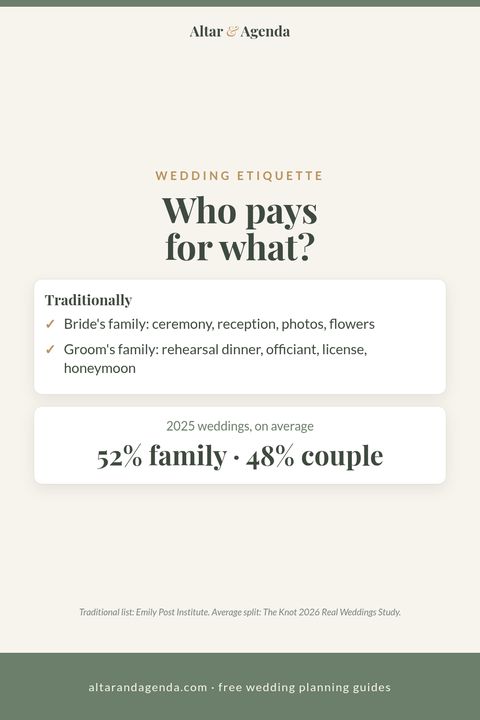
There used to be a clear rulebook for who pays for what in a wedding. Today there isn't, and most families mix and match. In The Knot 2026 Real Weddings Study, parents and family covered 52% of total wedding costs on average and couples 48%, and slightly more than half of couples had all or most of their wedding paid for by their parents.
Whatever your situation, the hard part isn't the math. It's agreeing on a total, being clear about what each contribution comes with, and tracking it so nobody's surprised. This guide covers the traditional split, four common modern approaches and how to start the conversation.
On this page
Who pays for what: the traditional split
The Emily Post Institute's traditional division (written for a bride and groom) looks like this:
| Traditionally paid by | Expenses |
|---|---|
| The bride and her family | Planner or consultant, invitations, the bride's dress, ceremony and reception flowers, music, all reception expenses, photographer and videographer, transportation for the wedding party, the groom's ring |
| The groom and his family | The bride's engagement and wedding rings, the groom's attire, the rehearsal dinner, the officiant's fee, the marriage license, the bride's bouquet and boutonnieres (in some regions), the honeymoon |
| Attendants | Their own attire and travel, and optionally a shower or bachelor or bachelorette party |
| Guests | Their own travel, lodging and a gift |
Emily Post is clear that these are a reference, not rules: "these days, all of the following guidelines for family expenses are variable."
How couples split wedding costs today
Emily Post lists several common modern approaches, and any combination works as long as everyone agrees. The four we see most often:
- Fixed contributions. Each family says how much they can give, and the couple plans around the total. This is the simplest way to avoid misunderstandings.
- By category. One family covers the venue, another the rehearsal dinner and photographer, the couple pays for attire and the honeymoon.
- Halves or thirds. Each family pays half, or the couple and both families pay a third each.
- The couple pays for everything. Increasingly common, and it keeps every decision with the two of you.
What changes with who pays? The Knot found average costs were $39,600 when the couple paid for a minority of the wedding, $29,700 when they paid the majority and $25,500 when they paid for all of it. Couples who spent over $41,000 had family contributions covering 62% of the bill on average, while couples spending under $12,000 mostly funded the wedding themselves.
How to have the money conversation
- Talk to each other first. Agree on what you can contribute, your top priorities and the guest count you have in mind.
- Ask, don't assume. Emily Post suggests starting with who is willing to pay for what and how much each person can contribute. That gives you your overall spending limit.
- Talk to each family separately if that's easier, then share the total.
- Ask what comes with the money. A contribution may come with expectations, like extra guests, a religious ceremony or a say in the venue. Talk about them openly and write them down.
- Agree on how it's paid. A lump sum to the couple, payments direct to specific vendors, or reimbursements. Agree on dates, because vendor deposits are often due early.
- Thank every contributor, and keep them updated on how the money is being spent.
Remember that, as Emily Post puts it, the wedding belongs to the couple, regardless of who is paying.
Track who paid for what
Once money comes from more than one place, track it in one budget:
- Add a "Paid by" column next to each category or vendor.
- Record each contribution received and the date.
- Keep a running total per contributor, so you can see what's been spent of each person's gift.
- Share a read-only copy with contributors if that helps keep things calm.
Our wedding budget spreadsheet guide shows the formulas, and the free Wedding Budget Starter gets you started with categories and allocations. If you don't know your total yet, try the wedding budget calculator with a few different numbers, or see our breakdowns of a $15K and a $30K wedding.
Splitting the smaller events
- Rehearsal dinner: traditionally the groom's family, but the couple, the bride's family or both families together are all fine (Emily Post). See our rehearsal dinner checklist.
- Bridal shower: hosted and paid for by whoever throws it, but not by the couple. See our bridal shower checklist.
- Bachelor and bachelorette parties: usually split among the attendees. A shared expense log stops anyone from being out of pocket.
Frequently asked questions
Who traditionally pays for the wedding?
Traditionally the bride's family paid for the ceremony, reception, photography, flowers, music and invitations, and the groom's family paid for the rehearsal dinner, officiant, marriage license, the bride's rings and the honeymoon. Today, costs are usually shared in whatever way works.
How do most couples split wedding costs now?
There's no single standard. Parents and family covered 52% of 2025 wedding costs on average and couples 48% (The Knot). Common approaches are fixed contributions, splitting by category, halves or thirds, or the couple paying for everything.
Does the family that pays more get more guests?
Only if you agree to it. Discuss expectations like extra guests up front, before you plan around the money, and write the agreement down.
What if one family can't contribute?
That's common and fine. Thank both families for whatever they can offer, money or otherwise, and avoid comparing contributions in front of anyone.
Want it done for you?
Our Wedding Budget Tracker for Excel and Google Sheets has a payment schedule with due dates and an expenses log, so you can record who paid for each item. The Wedding Budget Playbook includes a budget split worksheet for the family conversation, and the Rehearsal Dinner Planner has a cost split for families sharing that bill.
Sources
- Emily Post Institute, Wedding Expenses: The Traditional Division: the traditional list of expenses by family, attendants and guests.
- Emily Post Institute, Wedding Expenses: Who Pays for What?: modern solutions, starting the conversation and "the power to veto".
- Emily Post Institute, The Rehearsal Dinner: who hosts the rehearsal dinner.
- The Knot, 2026 Real Weddings Study data read-out: share of costs paid by family and couples, and family contributions by spending level.
- The Knot, The Average Wedding Cost, According to The Knot Data: average cost by how much the couple pays.
Disclosure: Altar & Agenda makes the templates linked above.
Free: the Wedding Budget Starter spreadsheet
Type your total and guest count, and it splits your budget into 13 categories, tracks quotes and payments and flags anything over budget. Excel and Google Sheets.
Get the free budget spreadsheetFree 12-month checklist (no sign-up)Browse our planners on Etsy